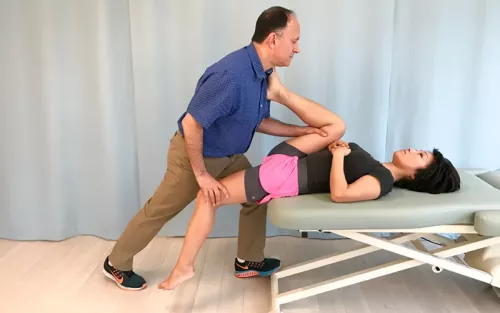
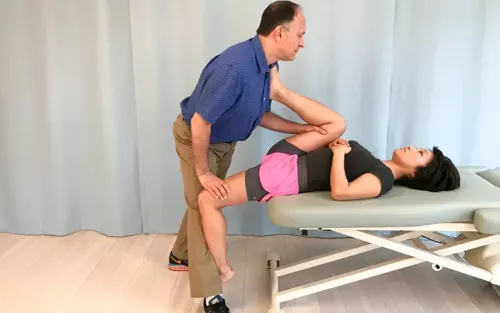
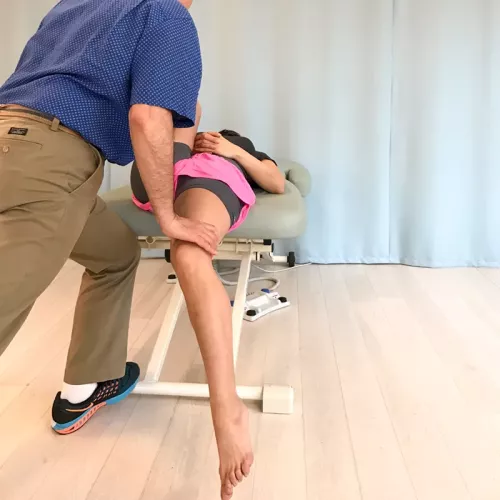
It is often said that the psoas major can be stretched by having the client lie supine at the end of the massage table and then extending the thigh down below the level of the table (Image 1). But does this actually stretch the psoas major? The answer to this question involves an understanding of what can be called the shortest rope.1
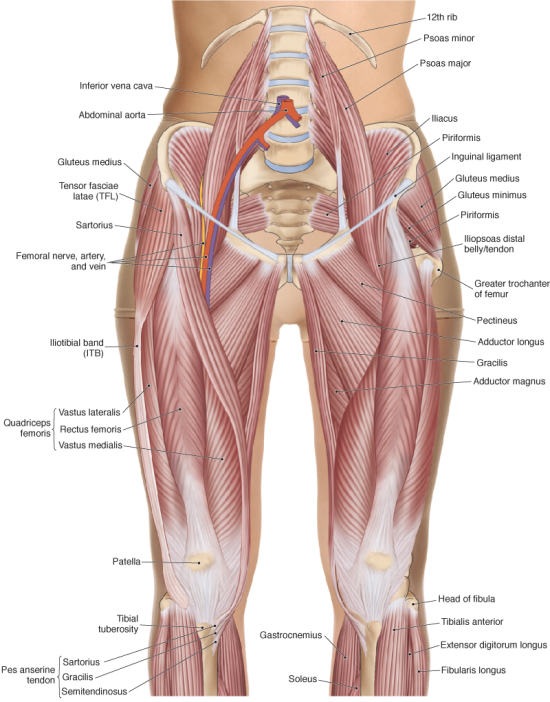
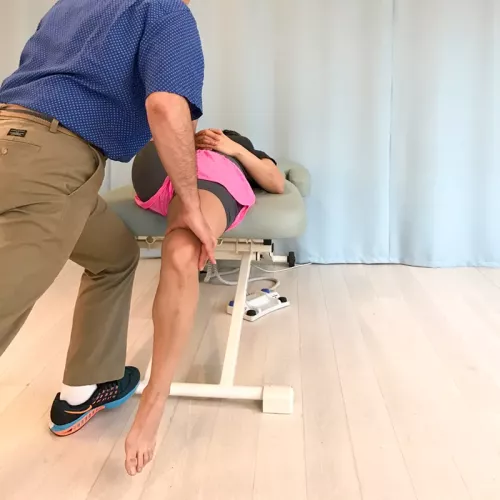
The shortest rope is a concept that is involved when stretching a functional group of muscles. Stretching is essentially a mechanical process that involves lengthening soft tissue, more specifically muscular/myofascial tissue. And a functional group of muscles is a group of muscles that all share the same mover action—in other words, the same function. The psoas major is part of the functional group of hip flexors (Image 2). So, given that the psoas major is a flexor of the thigh at the hip joint, shouldn't bringing the client's thigh into extension stretch it? Not necessarily.
Image 1. This therapist-assisted hip flexor stretch shown here for the left side of the body is often used to stretch the psoas major. But does this stretch position actually succeed in stretching the psoas major? All images courtesy Joseph E. Muscolino.
The reason this position might not succeed in stretching the psoas major is that the psoas major is not the only member of the functional group of hip flexors. It is only one of 12 muscles that cross the hip joint anteriorly—from the anterior fibers of the gluteus minimus and medius laterally to the adductor magnus medially (see "The Hip Flexor Group" sidebar).
So even though the position shown in Image 1 will place a stretch force on the hip flexor group and, therefore, theoretically stretch every one of the hip flexors (including the psoas major), in reality, it will not stretch every one of the muscles of this group and, therefore, may not stretch the psoas major. Instead, it will stretch only one muscle of the functional group. Which one? Whichever hip flexor is the shortest/tightest one of the group.
The Hip Flexor Group
Gluteus medius (anterior fibers)
Gluteus minimus (anterior fibers)
Tensor fasciae latae (TFL)
Rectus femoris (of the quadriceps femoris)
Sartorius
Iliacus
Psoas major
Pectineus
Adductor longus
Adductor brevis
Gracilis
Adductor magnus (anterior head)
This shortest/tightest muscle will stop the stretch force, preventing it from stretching the other members of the group. This muscle can be called the shortest rope.
Image 2. The functional group of hip flexors. Image from Joe Muscolino's The Muscular System Manual, The Skeletal Muscles of the Human Body, 4th ed. (Elsevier, 2016).
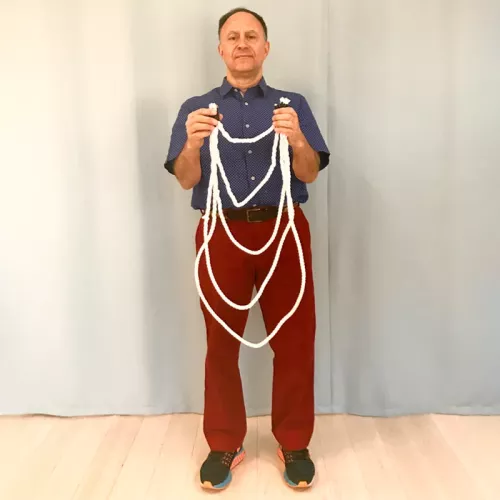
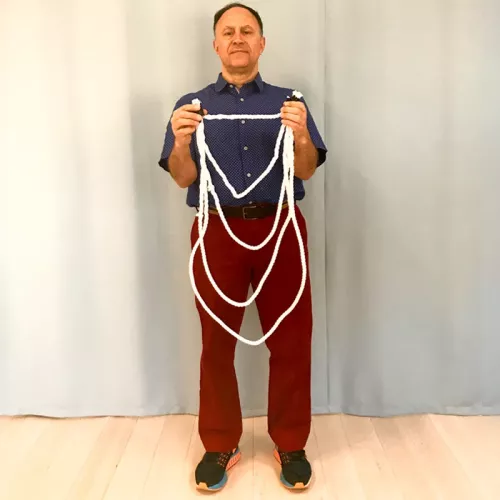
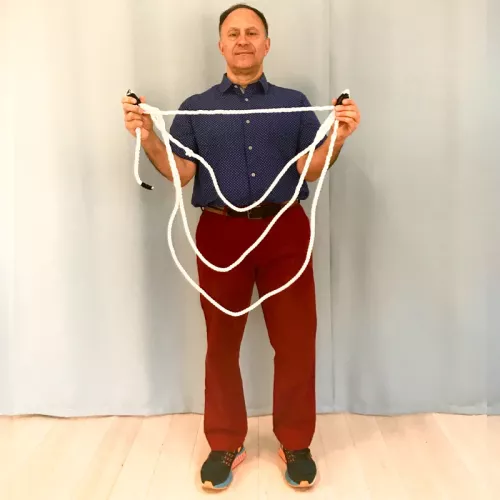
The shortest rope analogy can be best understood by picturing a person holding five ropes: one of the ropes is 1 foot long, another is 2 feet long, another is 3 feet long, another 4 feet long, and the last one is 5 feet long. All five of the ropes are being held by their ends and the ropes are hanging slack (Image 3A). In this analogy, the five ropes represent five muscles of a functional group, and the ends of the ropes represent the muscles' attachments. When the person starts to pull the ends of the ropes away from each other, all five ropes will lengthen until the shortest rope (the 1-foot rope) becomes taut and stops the movement. The shortest rope is pulled taut but the rest of the ropes will remain slackened (Image 3B). Imagining these ropes as a functional group of muscles, if a stretch force is placed on them, all five muscles will lengthen until the shortest/tightest muscle becomes taut and stops the lengthening movement.
Image 3A. All five ropes are being held by their ends ("attachments") and hanging slack.Image 3B. The "attachments" are brought away from each other until the shortest (1 foot) rope stops the movement.
In other words, the tightest muscle will be stretched, but when its stretch limit is reached, it will prevent the other muscles in the group from being lengthened and stretched. In effect, when a stretch force is placed on a functional group of muscles, only the tightest muscle will actually be stretched. (Of course, if two muscles of a functional group are exactly equally short/tight, then it is possible for two muscles of the group to be stretched. In effect, we would have two equally tight "shortest ropes.") If that shortest rope is removed from the equation (Image 3C), the next shortest rope (the 2-foot rope) will then become the shortest rope and stop the stretch.
Image 3C. The shortest rope is removed from the equation and then the next shortest (2 foot) rope becomes the shortest rope and stops the movement.
How Do We Stretch a Muscle?
Stretching a muscle is actually quite a simple affair. Given that a muscle's joint actions are its shortening concentric functions, and that stretching is lengthening the muscle, a stretch for any muscle can be easily figured out by doing the opposite of the muscle's joint actions. And, if we perform the opposite of every one of the muscle's actions, we will have the most efficient and effective multiplane stretch for that muscle.
The price to pay for this simple approach? A knowledge of all the actions of the target muscle, as well as a knowledge of all the actions of the adjacent muscles in the functional groups of the target muscle. But, given that joint actions can be reasoned out from the line of the pull of the muscle, which follows from its attachments, knowing joint actions should not be difficult. They do not need to be memorized; they can be figured out. The challenge is to learn the attachments of the muscles. The actions and how to stretch the muscles can be reasoned from there.
So, let's now return to our hip flexor stretch seen in Image 1. When the thigh is brought down into extension, one of the 12 hip flexors will be the shortest rope and will be stretched. But it may not be the psoas major; it could easily be one of the other members of the group. But what if our goal is to make the psoas major, or another one of the members of the hip flexor group, the target of our stretch? There may be many reasons for this. Perhaps one of the muscles is the pain-generating structure in our client's symptomatic pattern, whether due to local pain or myofascial trigger point referral to distant sites; or perhaps it is involved in the client's dysfunctional postural or movement pattern. Regardless of the reason, if one member of the hip flexor group is our target muscle, we need to find a way for it to be the shortest rope of the group.
Multiplane Stretching
To find the shortest rope of the group requires an understanding of multiplane stretching. The members of a functional group are collected together based on sharing one cardinal plane action—the three cardinal planes are the sagittal, frontal, and transverse planes (the frontal plane is also known as the coronal plane and the transverse plane is also known as the horizontal plane). In the case of the hip flexors, they all share the sagittal plane action of flexion of the thigh at the hip joint (or sagittal plane anterior tilt of the pelvis at the hip joint; see "Hip Flexors or Anterior Tilters?" below).
However, every one of the muscles of the hip flexor group also possesses one or more other joint actions, either in different planes at the hip joint or at another joint. For example, the tensor fasciae latae (TFL) is also a medial rotator in the transverse plane, as well as an abductor in the frontal plane. The sartorius is also a lateral rotator in the transverse plane and an abductor in the frontal plane, as well as a flexor of the knee joint in the sagittal plane. The adductor longus is also an adductor in the frontal plane and (weak) medial rotator in the transverse plane. And the rectus femoris of the quadriceps group is an extensor of the knee joint in the sagittal plane.
Knowing these other joint actions allows us to tweak the position of the stretch so that we can target a specific member of the functional group to become the shortest rope. We tweak the stretch position by adding in component joint action positions in the other planes. For each component cardinal plane joint action position that we add to the stretch, we either increase the lengthening stretch of one or more of the muscles, or slacken and decrease the lengthening stretch to one or more of the muscles.
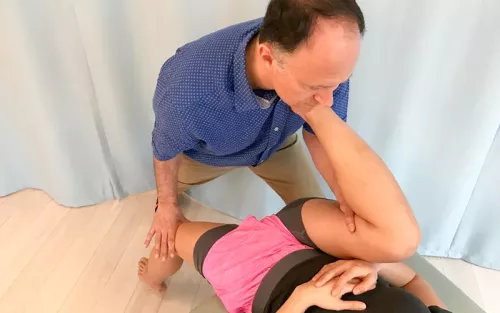
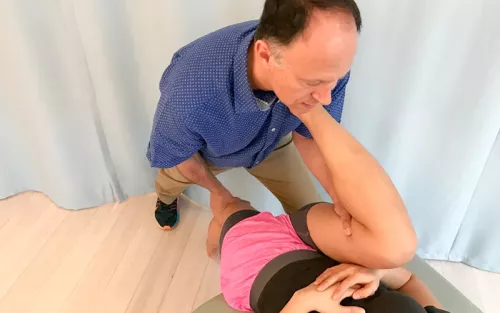
Image 4. Knee joint flexion is added to the hip flexor stretch.
For example, if we add flexion of the knee joint while performing the stretch seen in Image 1, then the rectus femoris becomes the shortest rope because it is pulled taut across both the hip and knee joints; and hip flexors that are knee flexors such as the gracilis and sartorius will be slackened and knocked out of the stretch (Image 4).
Image 5. Hip joint abduction is added to the hip flexor stretch.
If, instead, we add abduction of the thigh at the hip joint to the stretch (Image 5), we increase the stretch to the hip flexors that are also adductors—pectineus; adductors longus, brevis, and longus; and the gracilis—but we decrease the stretch to the hip flexors that are abductors, such as the TFL and sartorius. If we add adduction, then the adductors are slackened and the abductors (e.g., TFL and sartorius) are preferentially stretched (Image 6).
Image 6. Hip joint adduction is added to the hip flexor stretch.
If we add medial rotation (Image 7), the stretch will preferentially move to the hip flexors that are lateral rotators, such as the sartorius, iliacus, and psoas major, but the medial rotators, such as the TFL and the muscles of the adductor group, will be slackened and knocked out of the stretch. And, if we add lateral rotation (Image 8), the flexors that are lateral rotators will be slackened and the hip flexors that are medial rotators are preferentially stretched.
Image 7. Hip joint medial rotation is added to the hip flexor stretch.Image 8. Hip joint lateral rotation is added to the hip flexor stretch.
Thus, we see that for each component cardinal plane joint action position that we add to the stretch, we can preferentially move the stretch to certain muscles of the group and/or lessen the stretch to other muscles of the group. Multiplane stretching can be performed by adding one or both of the other two cardinal plane joint action components to the stretch (as well as joint actions at other joints).
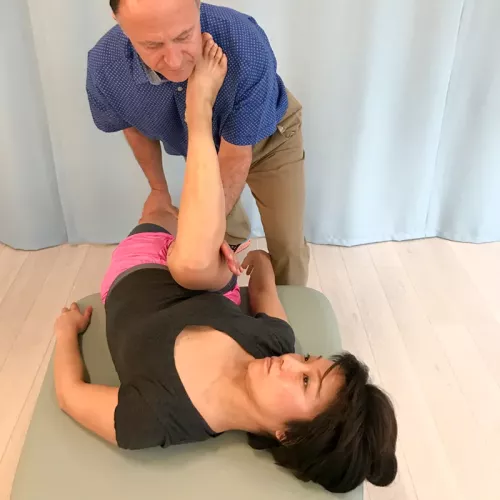
So, let's now return to our question of stretching the psoas major. How can we best employ multiplane stretching to make the psoas major the shortest rope? The most effective way to accomplish this is to work with the spine. Within the hip flexor group, only the psoas major crosses and moves the spine. In the supine hip flexor stretch shown in Image 1, we cannot easily take advantage of the sagittal plane joint action across the spine, but we can take full advantage of the frontal plane spinal action of the psoas major. The psoas major is a same-side (ipsilateral) lateral flexor of the spine. This means that if our target muscle is the left-side psoas major, it is a left lateral flexor and, therefore, would be more efficiently stretched if the client's trunk is in right lateral flexion, as seen in Image 9. Of course, there is a limit to the effectiveness of multiplane stretching toward making a muscle the shortest rope.
Image 9. The psoas major becomes the shortest rope with opposite-side lateral flexion of the spine added to the hip flexor stretch.
If one of the client's hip flexors is extremely tight, it is possible that no matter what component joint action positions are added, that extremely tight muscle will remain the shortest rope and will limit our ability to stretch our target muscle.
Hip Flexors or Anterior Tilters?
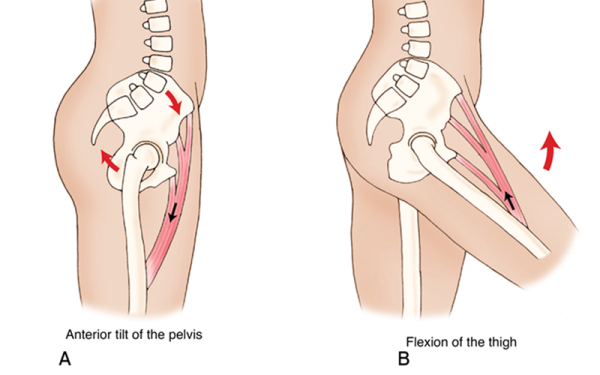
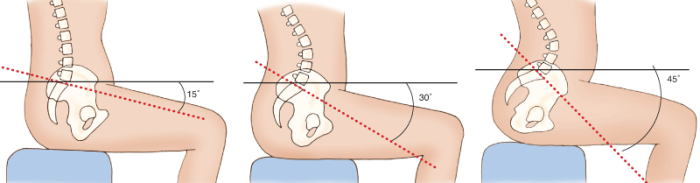
The muscles that anteriorly cross the hip joint are usually referred to as the hip flexor group. But this group could just as easily be called the anterior tilt group. When a muscle contracts, it cannot pull on only one of its attachments; rather, it must pull equally on both of its attachments. In the case of the muscles of the hip flexor group, they pull on both the femur and the pelvis. So, they can anteriorly tilt the pelvis at the hip joint as well as flex the thigh at the hip joint (see accompanying images A and B below).
Image from Joe Muscolino's Kinesiology: The Skeletal System and Muscle Function, 3rd ed. (Elsevier, 2017).
When a muscle contracts and moves its proximal attachment, it is often referred to as a reverse action (or a closed-chain action). Even though reverse actions are not often learned, they are actually quite common. And it can be argued that these reverse closed-chain actions of the pelvis are more important than the standard (open-chain) actions of the thigh. At least they are in the world of manual and movement therapy.
Image C. Images from Joe Muscolino's Kinesiology: The Skeletal System and Muscle Function, 3rd ed. (Elsevier, 2017).
Joseph Muscolino is offering his Digital Clinical Orthopedic Manual Therapy streaming subscription service at a deep discount to ABMP members. This service contains all his video content, plus new content uploaded each week. For more information, visit his website at www.learnmuscles.com/abmp.
When there is an asymmetrical muscular pull on the pelvis, it results in a postural distortion pattern of the pelvis. Because the spine sits on the pelvis, this then results in a postural distortion pattern of the spine. For example, if the hip flexor/anterior tilters are excessively tight (locked short, overpowering the hip extensor/posterior tilters), the pelvis will be held in excessive anterior tilt. Image C (above) shows an excessively anteriorly tilted pelvis (measured by a sacral base angle of 45 degrees), resulting in a hyperlordotic lumbar curve and jamming of the facet joints.
So, given the importance of pelvic posture toward determining spinal posture, perhaps we should not be referring to this group as the hip flexor group, but rather as the anterior tilt group.
The Shortest Rope at the Neck
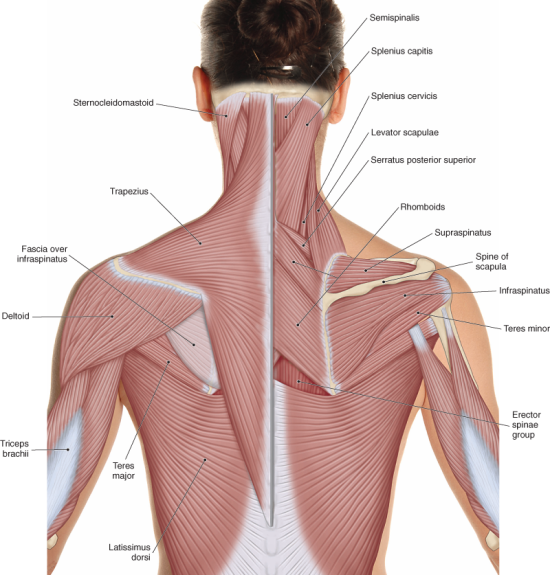
Image 10. The functional group of cervicocranial (neck/head) extensors. Image from Joe Muscolino's The Muscular System Manual: The Skeletal Muscles of the Human Body, 4th ed. (Elsevier, 2016).
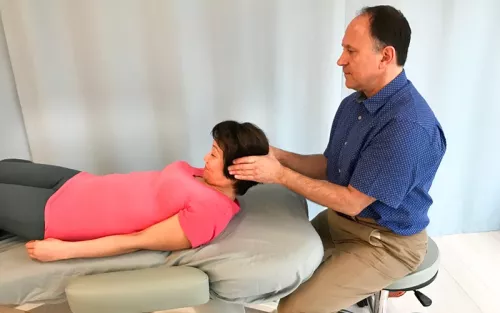
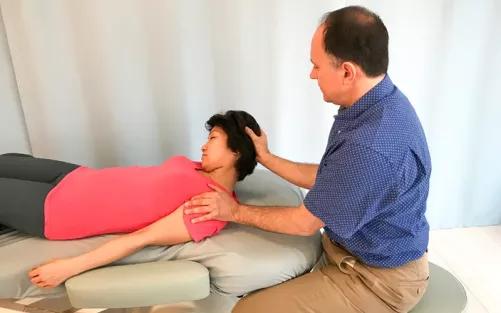
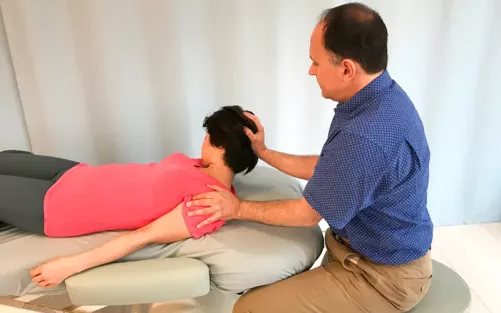
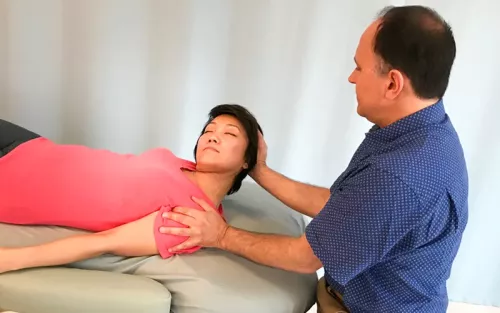
The concept of multiplane stretching to create the shortest rope can be efficiently applied to any functional group in any region of the body, for example, the neck (Image 10). If we simply stretch a client's neck into flexion, then all extensors would theoretically be stretched (Image 11). If we add in a frontal plane component and stretch the client's neck into flexion plus right lateral flexion, we have now narrowed the stretch to all extensors that are left lateral flexors—located in the posterior left quadrant of the neck (Image 12).
Image 11. Stretch the functional group of cervicocranial (neck/head) extensors by moving the client's neck/head into flexion.Image 12. Transition the stretch seen in Image 11 into a multiplane stretch by adding in frontal plane right lateral flexion.
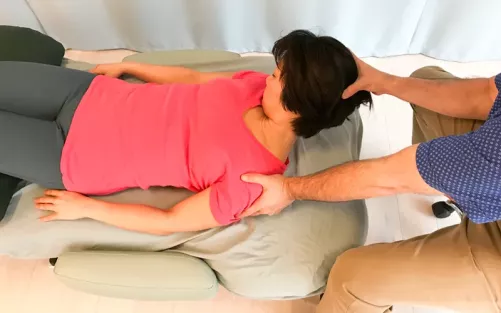
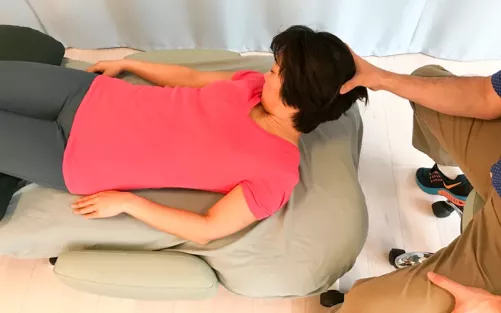
But what if our desire is to specifically stretch the left upper trapezius of the posterior left quadrant? Then, because the left upper trapezius is a contralateral rotator (i.e., a right rotator), we need to add ipsilateral/left rotation to the stretch (Image 13A). If instead we want to target the left splenius capitis or levator scapulae in the posterior left upper quadrant, then we would instead need to add contralateral/right rotation because these muscles are ipsilateral/left rotators (Image 13B).
Image 13A. Further transition the stretch seen in Image 12 by adding in a transverse plane component motion. In 13A, left rotation has been added.Image 13B. Right rotation has been added.
Now suppose we want to distinguish between the left splenius capitis and left levator scapulae? At first, this might seem impossible because both of these muscles are extensors, left lateral flexors, and left rotators of the cervical spine. But we take advantage of the difference at the other attachment of these two muscles. The levator scapulae attaches to the scapula so that if the scapula is stabilized and/or depressed, this position will tend to preferentially stretch the levator scapulae (Image 14A). But, if we let the scapula elevate as the client's cervicocranial region (head/neck) is moved, then the levator scapulae will be slackened and knocked out of the stretch, and the splenius capitis will likely become the shortest rope and best targeted to be stretched (Image 14B).
Image 14A. Further transition and refine the multiplane stretch seen in Figure 13B by working with the position of the scapula. Here, the scapula is stabilized down into depression.Image 14B. The scapula is allowed to elevate.
Stretching can be an extremely important treatment tool to add to our clinical orthopedic manual therapy practice. But learning how to stretch effectively requires an appreciation of the shortest rope analogy and an understanding of multiplane stretching. The shortest rope teaches us that a simple cardinal-plane stretch position will not necessarily be effective. But by then employing multiplane stretching technique, we will be empowered to critically think and creatively apply our stretching technique so that the target musculature is specifically and effectively lengthened and stretched, thereby helping us to achieve our treatment goals for our clients.
To understand tissue-tension barriers, MTs must be constantly present and mindful. Too light and we will not become efficient at creating the healing change that is needed.